A total of 8,640 U.S. retail stores closed in 2017 as part of what some call a "retail apocalypse." [1] Despite the recovering economy, that’s nearly five times the number of store closures four years ago. In fact, the number of store closures in 2017 is higher than during the peak of the financial crisis in 2008.
The impact will ripple through the economy in many ways. Credit Suisse estimates that up to 25 percent of all U.S. malls will close within the next five years. The mall closures will have a significant impact on chains such as J. C. Penney and Macy's. More than 10 percent of their stores anchor what Credit Suisse calls weak malls.[2]
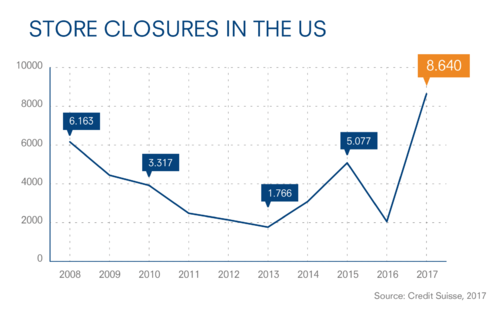
A report by the Retail Performance Company identifies the reason for the decline in retailstores. "E-commerce offers more comfort, transparency and a larger product range. In homes all around the world, customers fll their digital baskets sitting comfortably on their couches or they shop with their smartphone while they are commuting to work."
Footnotes:
- The Retail Performance Company, "The Future of Physical Retail," accessed April 27, 2018
- Fortune, "Major Wall Street Firm Expects 25% of U.S. Malls to Close by 2022," May 31, 2017
Each weekday, Scott Rasmussen’s Number of the Day explores interesting and newsworthy topics at the intersection of culture, politics, and technology. Columns published on Ballotpedia reflect the views of the author.
Scott Rasmussen is founder and president of the Rasmussen Media Group. He is the author of "Mad as Hell: How the Tea Party Movement Is Fundamentally Remaking Our Two-Party System," "In Search of Self-Governance," and "The People’s Money: How Voters Will Balance the Budget and Eliminate the Federal Debt." Read more reports from Scott Rasmussen — Click Here Now.
© 2026 Newsmax. All rights reserved.