In a defiant, make-or-break speech sure to define his Republican presidential bid, Mitt Romney called for the repeal of Obamacare Thursday but refused to back down from the controversial and sweeping healthcare plan he enacted as governor of Massachusetts.
The key question now will be if Romney’s position can mollify enough critics in the GOP’s conservative base to give his candidacy legs in a large but formidable field. Romney has the tough task of defending a plan that many on the right have slammed as “Romneycare.”
Backing away from the plan he signed as governor or changing his overall healthcare vision would be politically expedient given that healthcare has become a liability rather than an asset for him among conservative critics in the past two years, Romney said.
But he declared, "I am not adjusting the plan to reflect the political sentiment."
Instead of speaking from prepared remarks at a GOP-sponsored event at the University of Michigan’s Cardiovascular Center, he talked from notes and used a slide presentation to deliver what at times felt like a college lecture on health care, the Associated Press reported.
Comparing his state version with Obama's, he said, "Our plan was a state solution to a state problem. And his is a power grab by the federal government to put in place a one-size-fits plan across the nation." He added that his state's plan was "a more modest approach."
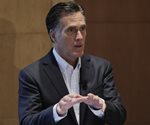
The law he backed as governor was right for Massachusetts but Obama's, which requires federally mandated health care coverage for all U.S. residents, is a bad idea and should be repealed, Romney stressed in remarks that broke no new policy ground from previous speeches.
He said that many pundits argue that he should stand up and say his own state law was a mistake, "that it was just a bone-headed idea and I should just admit it."
"There's only one problem with that," Romney said. "It wouldn't be honest. I, in fact, did what I believe was right for the people of my state."
That seems unlikely to placate his competitors or conservative critics of Romney’s signature achievement as governor of Massachusetts.
In a biting editorial Thursday, The Wall Street Journal said Romney’s healthcare plan as a costly liberal pipedream that actually laid the groundwork for Obamacare.
“The health reform Mr. Romney passed in 2006 as Massachusetts Governor was the prototype for President Obama's version and gave national health care a huge political boost,” the paper said. “Mr. Romney now claims Obamacare should be repealed, but his failure to explain his own role or admit any errors suggests serious flaws both in his candidacy and as a potential President.”
The Journal added that Romney “might as well try to knock off Joe Biden and get on the Obama ticket.”
Phil Klein of the Washington Examiner blasted Romney’s “desperate attempt to distance himself from ObamaCare,” pointing out several “failed defenses of RomneyCare” that Romney employed during the speech.
“Even worse, because the plans are so similar in structure, every time Romney defends his Massachusetts law, it is a de facto defense of the national health care law,” Klein wrote. “If Romney really is interested in repealing and replacing ObamaCare, the best thing he could do to help the cause is to stop running for president.”
Writing on the conservative Commentary magazine website, Alana Goodman suggested Romney is fighting an uphill battled: “With economic issues as a top concern for Americans, and Rep. Paul Ryan’s exceptional budget plan, Republicans have the rare opportunity to make this upcoming election a referendum on conservative small-government philosophy. By selecting Romney as the candidate, they could risk losing this chance.”
Larry Sabato, the director of the University of Virginia’s Center for Politics, said of the speech, “That’s all he can do. But Democrats and his GOP presidential opponents aren’t going to let him off that easy.”
Indeed, the Democratic National Committee put together a slide presentation entitled, “Mitt Romney on Health Care … Through the Years.” The presentation shows Romney supporting a federal plan in 1994 that included universal coverage and an individual mandate and noted Romneycare was supported by the late Sen. Ted Kennedy, D-Mass.
Sen. Rick Santorum, R-Pa., who is also a presidential contender, slammed Romney in a statement issued just minutes after the speech was finished.
“I greatly respect both Gov. Romney and admire many of his personal and professional accomplishments, but his work to institute the precursor to national socialized medicine is not one of them,” Santorum said in the statement.
“This not a failure of execution, but a lack of foresight on Gov. Romney's part to understand the implications of his policy proposals,” he continued. “We need leaders who believe in the American people again, not the power of government to solve our problems. Yes, the governor had the right to implement Romney-Obamacare at the state-level, but that does not make it the right thing to do."
Numerous analysts say Romney's Massachusetts law raised taxes indirectly, by redirecting Medicaid funds to pay for the expanded coverage.
"The states would be responsive to the people closest to them and the solutions could be tailored," Romney said. "My experience is that healthcare delivery in Massachusetts is different than Montana."
Romney previously has had to explain reversals in his stands on abortion and gay rights. Critics say the changes were a politically expedient way to transfer a Massachusetts moderate-liberal into a staunch conservative who could win GOP presidential primaries.
This time, the health care issue is one of Romney's biggest hurdles.
Like the federal law, the Massachusetts plan requires individuals to buy health insurance and imposes tax penalties on those who don't. Both plans penalize small businesses above a certain size that don't provide coverage to their employees. Both rely on new taxes for some of the financing.
The Associated Press contributed to this story.
© 2026 Newsmax. All rights reserved.