Hugo Chavez is back in Venezuela after weeks of cancer treatment in Cuba. For nearly a month he let his countrymen speculate as to the state of his health while he received the kind of world-class therapy that only members of the Cuban Communist Party, the military, and tourists who pay with hard currency can get in Cuba.
Normally, when a human being comes face to face with his mortality, he becomes more human and shows a softer side. Apparently Chavez is an exception.
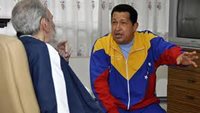 |
| Castro, Chavez |
In today’s Venezuela, not only is persecution of political opposition official government policy, but following his mentor Fidel Castro’s conduct in Cuba, Chavez’s treatment of political prisoners is particularly cruel.
It is a place similar to that described in “Animal Farm” by George Orwell’s fictional tyrant Napoleon the Pig, who asserted, “all animals are equal, but some are more equal than others.”
In Venezuela, some cancer patients are more equal than others.
Alejandro Pena Esclusa, a former journalist and politician falsely accused of terrorism, is suffering from colon cancer and still awaiting trial in one of Venezuela’s most dangerous prisons.
Pena Esclusa’s case required international attention before the government allowed him proper medical treatment. His plight was further highlighted this month when Paraguay’s parliament voted unanimously to demand his release.
Another cancer patient, Judge Maria Lourdes Afiuni, jailed at Chavez’s personal command for following the Venezuelan constitution and releasing a prisoner that had been incarcerated nearly three years without trial, has also attracted international attention.
The case of Afiuni is so blatantly unjust that it drew a rare condemnation of Hugo Chavez by his admirer Noam Chomsky, a noted American leftist who endorsed an international campaign to free Afiuni.
The difference in the treatment of these three Venezuelans — the two prisoners and their jailer — illustrates that under 21st century socialism the new class of rulers have access to the best healthcare, food, and state-controlled profit-making ventures, while the general population suffers.
While Chavez flies his daughters, ex-wife, mother and siblings on government jets to Havana to accompany him as he receives the best care money can buy in a Cuban hospital, paid for by the Venezuelan people, his political prisoners are taken to Venezuela’s crumbling public medical facilities to receive perfunctory medical care — and then only after an international outcry.
According to Chavez’s retelling upon his triumphant return to Caracas, he had enjoyed refreshing walks with his mentor Fidel Castro, who brought him specially-prepared exotic dishes, while Pena Esclusa and Afiuni were left to suffer inside their cramped, dark cells.
And while Chavez was provided with a private suite and consultations from doctors flown in from Europe solely to care for him, Afiuni was suffering the indignity of having male military officers present while being examined for breast cancer.
Pena Esclusa and Afiuni are only two of dozens of political prisoners that have been thrown in jail without trial in Venezuela. Perhaps politics, if not mercy, will motivate Chavez to release these prisoners to the care and comfort of their families.
Chavez faces an election next year that promises to be challenging, as his approval ratings have fallen in tandem with the vital signs of the country under his aegis.
Venezuelans not affiliated with the regime’s political party have been suffering endemic power blackouts, crumbling infrastructure and food shortages, more recently compounded by a doctor’s strike and deadly prison riots. In the absence of simple human decency, perhaps those suffering in Venezuela, in and out of jail, can hold out hope that the looming election turns out to be their salvation.
Otto Reich is a former U.S. ambassador to Venezuela, assistant secretary of state for the Western Hemisphere, and senior staff member of the National Security Council.
Jon Perdue is director of Latin America Programs at The Fund for American Studies in Washington, D.C., and the author of the forthcoming book on terrorism in Latin America, “The War of All the People” (Potomac Books).
© 2026 Newsmax. All rights reserved.