The retail industry is having its worst since the Great Recession with store closures and bankruptcy filings among former stalwarts like Toys R Us. And it’s only going to get worse, according to an analysis by Bloomberg News.
The main reason is the crushing debt load that many retailers carry, in many cases because of leveraged buyouts by private equity firms.
‘There are billions in borrowings on the balance sheets of troubled retailers, and sustaining that load is only going to become harder—even for healthy chains,” according to Bloomberg. “The debt coming due, along with America’s over-stored suburbs and the continued gains of online shopping, has all the makings of a disaster.”
Debt problems outweigh the positive trends seen in the broader economy, including solid consumer confidence and low unemployment. But there are worrisome trends, including consumer dependence on credit cards to finance their spending as wages stagnate.
Stores that have difficulty refinancing may be compelled to file for bankruptcy, which would hurt low-income workers, shrink sales tax revenue for state and local governments and trigger investor losses on stocks, bonds and real estate.
“The market has shifted, with the negative view on retail pushing investors to reconsider lending to them,” Bloomberg reports.
Toys R Us filed for bankruptcy after having trouble refinancing $400 million of its $5 billion in debt. The company is well established and has fairly stable sales, despite competition from discounters like Wal-Mart Stores and e-commerce giant Amazon.com.
Retailers that are forced to cut costs are likely to cut jobs, hurting the 8 million people who work as salespeople and cashiers.
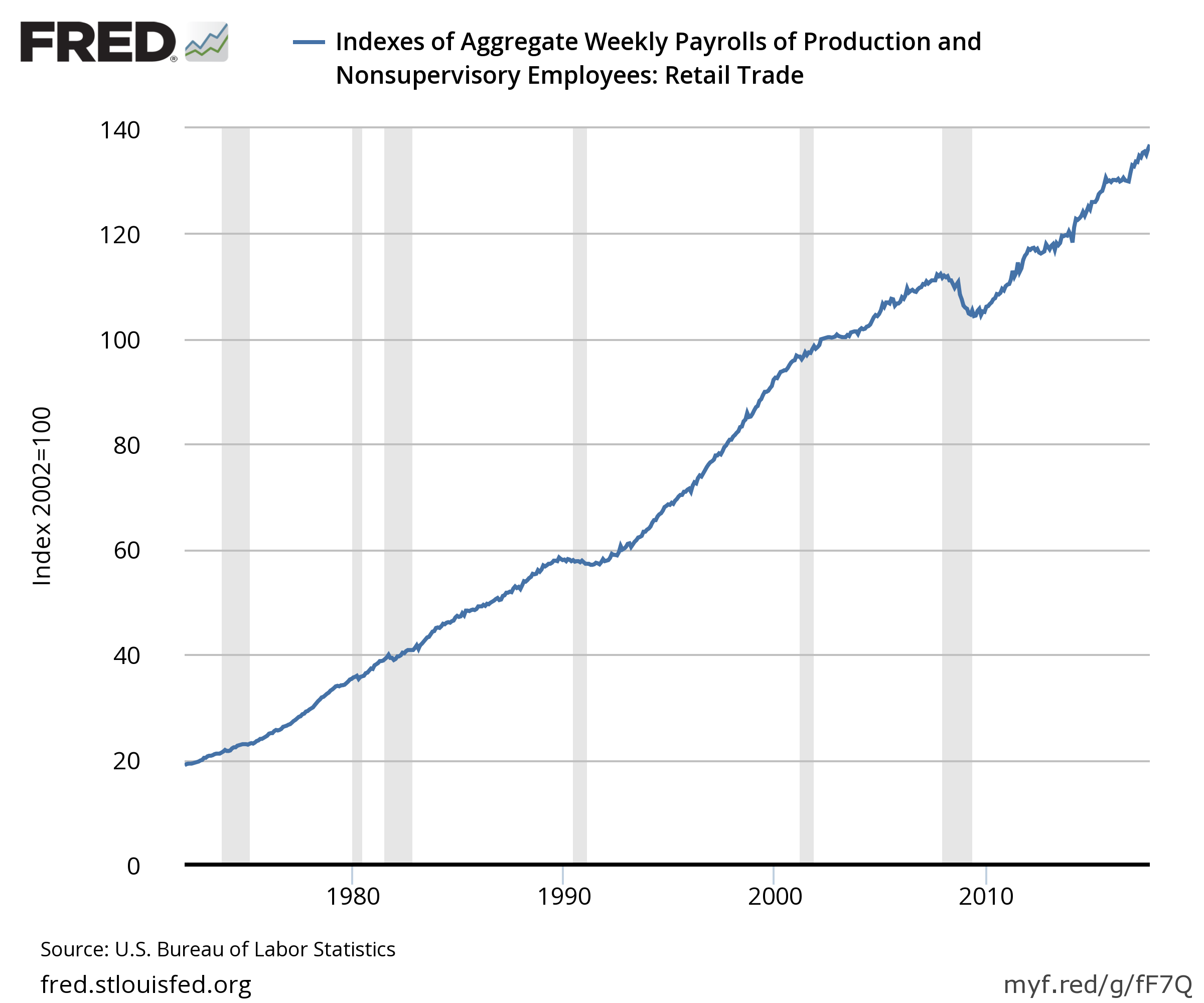
“During the height of the financial crisis, store workers felt the brunt of the pain when 1.2 million jobs disappeared,” according to Department of Labor data cited by Bloomberg.
Employment has bounced back, with aggregate hours worked rising to record levels, according to data from the Bureau of Labor Statistics.
.png.aspx?width=600&height=500 "fredgraph-(16).png")
States like Ohio, West Virginia, Michigan and Illinois have been among the hardest hit, with retail employment falling in the past decade. Nevada, Florida and Arkansas have relied on retail for job growth, and may feel more pain.
Alabama, Louisiana, New Hampshire, Mississippi and South Carolina have the highest concentration of cashiers, who have an average wage of $21,500 a year.
“The path to the middle class in retail is often to become a supervisor,” Bloomberg reports. “There are 1.2 million of them, and their average annual salary is more than twice that of a cashier at $44,000. In that category, many of the same states have the most on the line, with Alabama, West Virginia, South Carolina and Montana containing the highest ratio of these workers.”
E-commerce is still growing, which provides mixed opportunities. The industry is adding jobs at warehouses to support online operations, but many displaced retail workers don’t live near a shipping facility.
“The hiring also skews more toward men, as they make up two-thirds of the workforce, and retail store employees are 60 percent women,” Bloomberg reports.
© 2026 Newsmax Finance. All rights reserved.