Bear markets usually develop because of a fundamental change in the economy, but sometimes the carless remarks of a president or other government action can provide the spark for a deep selloff.
In 1962, President Kennedy was angered by a 3.5 percent increase in steel prices. In a speech he noted the increase showed "utter contempt for the interests of 185 million Americans." Government contracts were awarded only to steel companies that didn't raise prices and the attorney general, the president's brother, launched an investigation into the industry. The price hikes were quickly rolled back.
But the president's victory over big steel led to a 24.5 percent sell off in the Dow Jones Industrial Average. The Dow had been in a broad trading range near all-time highs for about a year prior to the president's speech and Kennedy provided the spark for a downside breakout.
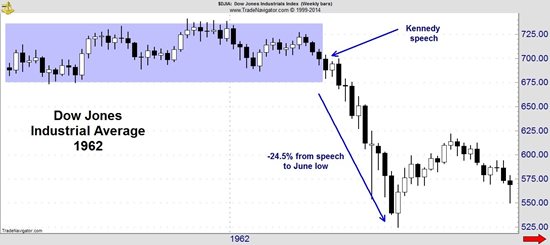
Kennedy's comments are just one example of how political actions affect the stock market. Changes in tariffs contributed to the 1929 crash and Secretary of the Treasury James Baker's comments about a weak dollar came just one day before the October 1987 crash.
Today, administration officials are angry about tax inversions that allow companies to lower their tax rates. Rather than allowing Congress to address the situation thoughtfully and deliberatively, President Obama had the Treasury secretary announce policy changes. The threat of immediate executive action now hangs over business decisions and creates an unfavorable business environment.
In 1962, stock prices moved lower slowly, but after three months, the losses added up to a large amount of money. This time we could see a similar pattern with a relentless downtrend rather than a crash.
Either way — a crash or a slow decline — history shows we should expect a destruction of wealth in response to the president's hasty actions.
© 2026 Newsmax Finance. All rights reserved.