An assortment of macroeconomic trends favor a reversal of fortune for the United States, so much so that predictions of America’s ultimate decline will soon ring as hollow as similar calls made in the 1980s following Japan’s sudden rise.
So argues Ambrose Evans-Pritchard, international business editor of the London daily The Telegraph, in a new column.
Evans-Pritchard cites then shale natural gas rush, which he argues will make the United States back into an energy power and turn the political and military assumptions of current energy policy inside out.
__________________________________________________________
Sick and Tired of Playing Retirement Roulette?
Fleeced by uncontrollable inflation, taxes, and dire unemployment, millions are being forced to dangerously gamble their life savings in the . . . Learn More About How You Can Protect Your Life Savings, Click Here.
__________________________________________________________
Meanwhile, the United States has played its cards right in regard to Chinese labor competition, he writes.
U.S. monetary policy essentially forced China to revalue the yuan or import inflation. China opted for inflation. Either way, however, China would lose its cheap-wage advantage, he writes. Global manufacturers are leading the way: Volkswagen, Samsung, Intel, GM, and Caterpillar increasingly choose USA.
“The gap in ‘productivity-adjusted wages’ will narrow from 22 percent of U.S. levels in 2005 to 43 percent (61 percent for the U.S. South) by 2015,” Evans-Pritchard writes.
“Add in shipping costs, reliability woes, technology piracy, and the advantage shifts back to the U.S.”
Don’t bet on a huge U.S. surge, he cautions. The world is still in trouble as the “global depression” grinds on. Yet the United States retains its edge in higher education and its population is growing rather than shrinking.
“It is almost the only economic power with a fertility rate above 2.0 — and therefore the ability to outgrow debt — in sharp contrast to the demographic decay awaiting Japan, China, Korea, Germany, Italy, and Russia,” Evans-Pritchard maintains.
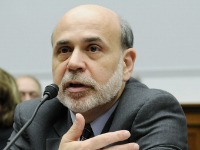 |
Ben Bernanke
(Getty Images photo) |
Federal Reserve Chairman Ben Bernanke, breaking with the practice of his recent predecessor, recently suggested that an activist Fed is possible. He argued in a speech that monetary policy could be used in the future to discourage speculation, in effect, to pop asset bubbles that might crop up.
“The possibility that monetary policy could be used directly to support financial stability goals, at least on the margin, should not be ruled out,” Bernanke said in a speech at the Boston Fed.
He also suggested that central banks around the world now view financial stability as a job equal to strict monetary policy.
“Central banks certainly did not ignore issues of financial stability in the decades before the recent crisis, but financial stability policy was often viewed as the junior partner to monetary policy,” Bernanke said.
© 2026 Newsmax Finance. All rights reserved.